Air Defense - TDS
- 4.7
- Rating
- 50.00K
- Installs
- Free
- Price
 Analysis by App-foxy
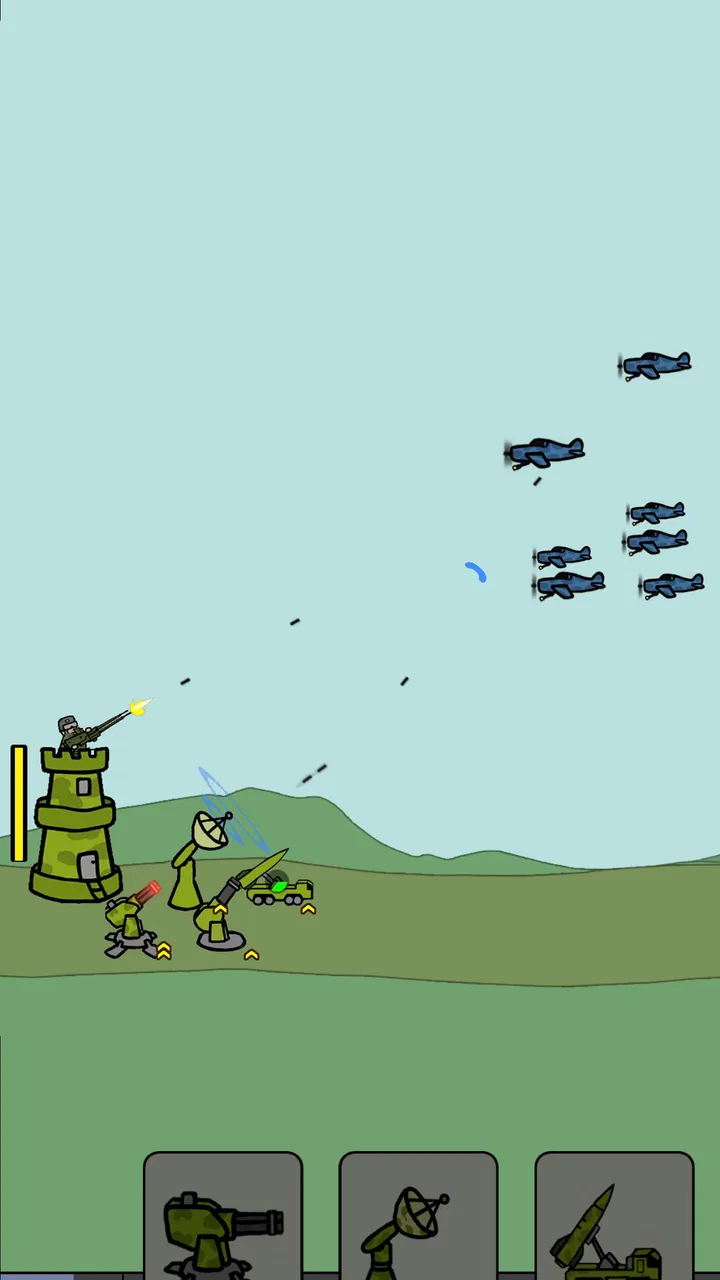
I spent time with Air Defense - TDS as a compact strategy game built around quick decisions rather than long planning sessions. Its central idea is easy to understand: protect the sky, react to incoming threats, and use swipes to aim your shots. That simple control scheme makes the game approachable within moments, but the real test is whether the action stays readable and satisfying when the pressure rises.
My first impression was that this is designed for short bursts of play. I could pick it up without studying a complicated interface, make a few defensive decisions, and put it down again without feeling committed to a lengthy campaign. That makes it a natural fit for a commute, a waiting room, or a brief break when I want something more active than a puzzle but less demanding than a full strategy title.
Developed by Supersonic Studios LTD, the game sits in the strategy category and is available free of charge. It is marked for Teen players, so it is better suited to older children and adults than to very young players. The current release is version 1.5.7, and the game supports devices running Android 7.0 or later. Its store summary focuses on swiping to shoot and defending the skies, and that description matches the immediate feel: the appeal comes from the direct connection between my finger movement and the defensive response on screen.
You May Also Like

 Blood Strike: 2.5 Anniversary
Blood Strike’s Loadouts Turn Every Drop Into a Tactical Gamble
A close look at Blood Strike’s custom loadouts: how fast access to signature weapons reshapes its battle royale rhythm, rewards preparation, and narrows the gap between fights.

 Pandora - Music & Podcasts
Pandora’s Music Is Easy to Start, but Harder to Recover
Pandora’s strength is its low-effort path from a seed to a station. Its weak spot is how much confidence it asks you to place in connection, setup, and quiet recovery.

 8 Ball Pool
 Is Built on Rivalries, Rematches, and Routine
A close look at the rivalries, rematches, shared routines, and unanswered safety questions that turn a quick pool match into a persistent mobile community.

 Samsung Music
’s Quiet Strength Is Playing What You Already Own
Its reach comes less from spectacle than from dependable access to a personal library. That simplicity is both the app’s strongest retention engine and its ceiling.

 AccuWeather: Weather Radar
AccuWeather Review: A Quick, Clear Forecast for Everyday Decisions
For everyday plans, the best forecast is the one you can understand quickly. AccuWeather makes rain timing, radar, and local conditions easy to act on, with a few trade-offs.

 Hill Climb Racing
Why Hill Climb Racing Still Turns Crashes Into One More Run
A tiny car, a bumpy hill and one more upgrade: Hill Climb Racing keeps resurfacing because its simple chaos makes every near-miss feel personal.
More From Our News Desk
View All News


How the pace feels during ordinary play
The perceived speed is one of the most important parts of this game. Air-defense games can become frustrating when targets move too quickly for the controls, or dull when every wave gives the player too much time to react. Here, the swipe-based approach keeps my attention on the screen because aiming is an active gesture rather than a passive tap through menus.
I found the opening moments easy to enter. There is no need to memorize a large set of commands before taking part. I can focus on identifying what needs attention, moving toward it, and deciding whether to act immediately or wait for a better opportunity. That creates a clean rhythm: observe, swipe, reassess, and repeat.
The important distinction is that the game feels fast because decisions arrive continuously, not because it requires frantic movement from the first second. That is a good choice for mobile play. I can understand what I am doing while still feeling that a missed reaction matters. Players who enjoy light tactical pressure will probably appreciate this balance more than people looking for a slow, highly detailed war simulation.
For a practical example, I could imagine playing it while waiting for a coffee order. I would not need to reserve half an hour or remember a complicated long-term plan. A short session can still provide a clear objective and a sense of completion. The trade-off is that this same accessibility may make it feel too lightweight for someone who wants deep base construction, extensive unit management, or a large campaign with many interconnected systems.
Why the swipe control matters
The swipe is more than a decorative control choice. It gives the game a physical quality that a standard tap-to-select system would not have. I am not simply choosing an option from a list; I am directing the defensive response. That makes small mistakes feel like my own timing or positioning error rather than an unclear menu interaction.
My advice is to avoid making every movement as quickly as possible. A rushed swipe may feel efficient, but taking a brief moment to confirm the target can produce a more controlled rhythm. This is one of the first useful habits I would recommend to a new player: treat the screen as a space to read, not just a place to react.
Another helpful approach is to keep my finger movements deliberate and consistent. When a game depends on gestures, changing from tiny nervous swipes to broad movements can make the experience feel less predictable. I found that a steady motion helped me stay focused, especially when several threats demanded attention in succession.
What happens when the screen gets busy
The most revealing moments come during heavier action. A quiet opening can make almost any defense game seem effortless, but crowded scenes test whether the controls remain understandable and whether the player can recover from a poor decision. This is where I paid most attention to perceived responsiveness and mental workload.
When several targets compete for attention, the challenge is not only aiming. It is deciding what deserves immediate action and what can wait. That priority judgment gives the game more strategic character than the simple swipe control might suggest. I had to resist the instinct to react to the most obvious object and instead consider which threat could cause the greatest problem if ignored.
A useful technique is to scan before acting whenever the situation allows it. I look across the full play area, identify the most urgent direction, and then make the gesture. This costs a small amount of time, but it reduces the chance of tunnel vision. In a game built around defending the skies, protecting one visible target while overlooking another is exactly the kind of mistake that a hurried player can make.
The game also works best when I accept that not every moment can be handled with the same tempo. Some situations reward quick movement, while others reward restraint. That change of pace is an important part of the strategy, and it prevents the swipe mechanic from becoming a mindless repeated gesture.
Resource demands during longer sessions
I would describe the game as a relatively focused mobile experience rather than a large, content-heavy strategy package. The available information identifies it as a free game with a straightforward air-defense concept, but it does not establish a demanding technical profile or a collection of advanced simulation systems. In practical terms, I would approach it as something intended for accessible play, not as a title that tries to reproduce a full desktop defense command center.
That distinction matters for expectations. If I want a game that launches quickly and gives me an immediate activity, this format makes sense. If I expect a huge battlefield, elaborate menus, or a deep economy that keeps expanding over long sessions, I may find the experience too narrow. The focused design is a strength for convenience, but it also defines the ceiling of the game’s complexity.
Heavy use is more likely to challenge my concentration than my device. Repeated swiping and constant scanning can become tiring before the game itself feels technically demanding. I would therefore recommend short sessions at first, especially if I am still learning how much attention each situation requires. That approach also makes it easier to notice whether the game’s loop has enough variety for my personal taste.
Stability, recovery, and the practical side of playing
Reliability is not only about whether a game opens. For me, it also includes how easy it is to return after an interruption, how clearly the current situation can be understood, and whether a brief session feels worthwhile. Air Defense - TDS is naturally suited to mobile interruptions because its basic interaction is immediate. I can think in terms of the current defensive moment instead of preparing a complicated control scheme every time I return.
That said, I would still avoid assuming that every session will feel identical on every phone. The game supports Android 7.0 and later, which makes it accessible across a broad range of Android devices, but supported software does not automatically mean identical screen size, touch sensitivity, or overall comfort. A smaller display may make fast scanning more difficult, while a larger one can give gestures more room to breathe.
Recovery is also connected to my own play style. If I lose focus, the best response is not always to swipe faster. I found it more useful to re-establish what is happening on screen and then resume a deliberate sequence. That is a small but meaningful difference between recovering from confusion and turning confusion into a chain of rushed decisions.
For people who play while multitasking, the game may be convenient but not completely forgiving. A notification, conversation, or brief distraction can interrupt the visual scan that the defense loop depends on. I would choose it over a slower turn-based strategy game when I want direct action, but I would choose a pause-friendly alternative when I know I will be interrupted repeatedly.
Free entry and the purchase question
The game is free to download, which makes it easy to test without committing money at the start. It includes in-app purchases ranging from $0.99 to $99.99 per item. That range is worth keeping in mind before playing extensively, particularly for anyone who prefers games with a clearly limited total cost.
My practical recommendation is to decide on a personal spending limit before exploring optional purchases. The free entry point is useful because it lets me judge the controls, pace, and replay appeal first. I would not buy anything simply because a difficult defensive moment made me impatient; the better test is whether I genuinely enjoy the core swiping and prioritization loop without relying on purchases to make it feel satisfying.
This is also where the game differs from traditional paid strategy titles. A premium strategy game may ask for money up front but offer a more predictable cost structure. Air Defense - TDS removes that initial barrier, which is helpful for casual players, while the presence of item purchases means families and younger Teen players should approach spending thoughtfully.
Device fit and who will enjoy it most
The Android requirement of 7.0 or later gives the game a practical advantage for people who do not use a recent phone. Still, the minimum operating-system support should not be confused with a promise that every older device will feel equally comfortable. Touch response, display proportions, and general device condition can all affect a gesture-driven game.
I would especially consider screen comfort. Because the main interaction depends on swiping and visual awareness, a display that feels cramped or difficult to read can make the game seem harder than it really is. Players with a larger phone or tablet may find it easier to survey the action, while someone using a compact handset may need to slow down and rely more on careful scanning.
Battery expectations should also be realistic. The game is built for active interaction, so it is not the sort of app I would treat like a passive background tool. I would use it when I have enough attention and a comfortable grip, rather than playing while walking or doing another task. That is less a criticism of the title than a consequence of its control design.
The audience fit is fairly clear. I think it is a good match for players who like quick strategy decisions, gesture controls, and defensive pressure without a long tutorial barrier. It may also work for someone who wants a compact alternative to larger tower-defense games. On the other hand, I would skip it if my priority is a rich story, detailed customization, competitive multiplayer, or a slow planning experience where I can pause after every decision.
How it compares with familiar strategy alternatives
Compared with conventional tower-defense games, this title feels more immediate because the swipe is central to the action. Traditional tower defense usually emphasizes placing structures, improving them, and shaping a defensive layout over time. Air Defense - TDS puts more weight on my moment-to-moment response, so it is better for active engagement than for designing a permanent maze of defenses.
Compared with large real-time strategy games, it is far less intimidating. I am not managing a broad economy or juggling several production lines. That makes it easier to start, but it also means the strategic depth comes from prioritization and timing rather than from a wide command system. Players who want a quick tactical challenge may prefer that focus; players who enjoy complex planning may want something more substantial.
Compared with casual arcade shooters, the defensive framing gives my actions a clearer purpose. I am not merely chasing a high score through constant movement. I am trying to keep control of a threatened space, which encourages me to think about sequence and urgency. The result sits between arcade reaction and light strategy, and that middle ground is the game’s strongest identity.
My performance verdict after weighing the trade-offs
Air Defense - TDS succeeds when I treat it as a focused, gesture-driven strategy game for short sessions. Its strongest qualities are the direct controls, the easy entry point, and the way a simple defensive premise can create pressure through target priority. The average rating of 4.7, based on around 900 ratings, suggests that the basic concept is connecting with many players, while its 50K-plus installs show that it has found an audience without presenting itself as a massive strategy platform.
I would not describe it as a replacement for a full tower-defense campaign or a deep real-time strategy game. Its appeal is narrower and more immediate. The experience depends heavily on whether I enjoy scanning the screen, making quick choices, and using swipes as the main form of control. If that loop clicks, the simplicity becomes a benefit. If I need extensive progression systems or a large set of strategic tools, the same simplicity may feel limiting.
The game’s free price makes trying it straightforward, but the in-app purchase range means I would keep spending under control and judge the core experience first. The Teen rating is another reason to consider the intended audience rather than treating it as a universal family game. On a compatible Android device, I would expect the most satisfying use to come from short, focused sessions where I can give the screen my full attention.
My recommendation is positive, with clear limits: try it if you want quick air-defense decisions, simple gesture controls, and a strategy game that does not demand a long setup. Skip it if you are looking for deep construction, extensive management, or a calm experience that tolerates constant interruptions. For me, its value comes from being easy to start while still asking me to think under pressure, and that is enough to make it a worthwhile free option in the mobile strategy space.
FAQs for Air Defense - TDS
01What is Air Defense - TDS and how does it work?
Air Defense - TDS is a thrilling tower defense game where players must strategically place defense towers to protect their base from waves of aerial attackers. The game involves real-time strategy and quick decision-making, as players upgrade and manage their defenses to withstand increasing levels of difficulty.
02Is Air Defense - TDS available for both Android and iOS devices?
Yes, Air Defense - TDS is available on both Android and iOS platforms. You can download it from the Google Play Store for Android devices and the Apple App Store for iOS devices. Make sure to check the app's compatibility with your device's version before downloading.
03Does Air Defense - TDS require an internet connection to play?
Air Defense - TDS can be played offline, making it perfect for on-the-go gaming without the need for a constant internet connection. However, some features, like in-game purchases or leaderboards, may require a connection to fully access or update.
04Are there in-app purchases in Air Defense - TDS?
Yes, Air Defense - TDS includes in-app purchases. Players can buy items like power-ups or special towers to enhance gameplay. While these purchases can provide advantages, the game is designed to be enjoyable without spending money, offering a balanced experience for all players.
05How does the difficulty level progress in Air Defense - TDS?
The difficulty in Air Defense - TDS increases with each level, presenting more challenging waves of enemies and requiring more strategic planning. Players must continuously upgrade their towers and adapt their strategies to succeed. This progression keeps the game engaging and rewards skillful play.
Pros
- Engaging gameplay with strategic depth.
- Smooth controls enhance gaming experience.
- Diverse range of challenging levels.
- Visually appealing graphics and effects.
- Regular updates with new content.
Cons
- In-app purchases can be pricey.
- Occasional ads disrupt immersion.
- Requires internet for full features.
- Battery consumption is high during play.
- Limited offline gameplay options.

Air Defense - TDS
Gallery